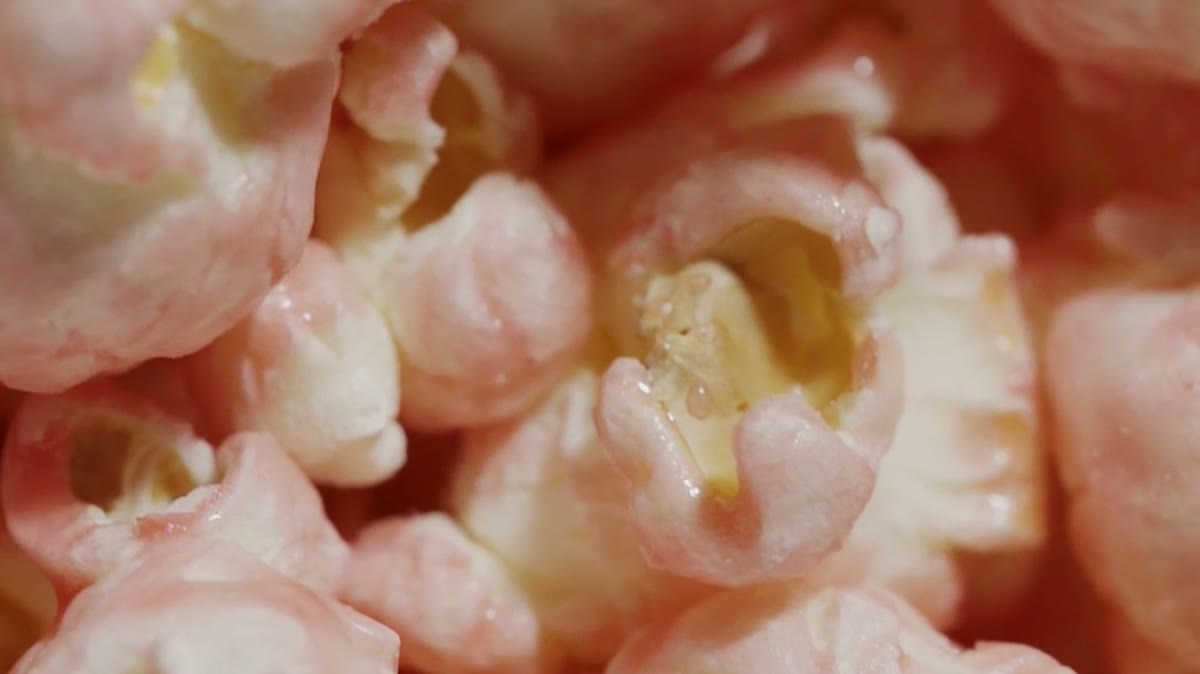

Why does popcorn pop, while a kernel of ordinary corn just sits in the pan and burns? The answer is hidden inside every kernel: a tiny drop of water, sealed behind a hull that is unusually hard and nearly waterproof.
A drop of water in a sealed box
According to Purdue University's College of Agriculture, a popcorn kernel needs moisture of about 13 to 14.5 percent of its total weight to pop well. That water sits inside the soft, starchy center of the kernel, surrounded by a tough outer hull.
Most grains let moisture escape as they heat up. Popcorn does not. Its hull is strong enough to hold the water in, and that is exactly what turns the kernel into a small pressure cooker.
From water to steam
As the kernel heats, the water inside turns into steam. Steam takes up far more space than liquid water, but it has nowhere to go. The pressure inside the kernel climbs, and the starch around it softens in the heat.
Purdue describes what happens next: at a threshold, the hull ruptures, and the hot starch expands almost instantly. The kernel is literally turned inside out, and the starch sets into the white, airy foam we eat.
The magic number: about 180 degrees
In 2015, physicists Emmanuel Virot and Alexandre Ponomarenko filmed kernels popping with high-speed cameras and published their results in the Journal of the Royal Society Interface. As reported by Scientific American, they found that nearly all kernels had popped by the time they reached about 180 degrees Celsius (356 degrees Fahrenheit).
The pop is not the shell cracking
The same study answered a question most people never think to ask: what makes the popping sound? You might guess it is the hull breaking. It is not.
The researchers found that the sound arrives about 100 milliseconds after the kernel splits open, too late to be the crack itself. They attributed the pop to the sudden release of water vapor escaping from the kernel.
So the next time you hear a bowl of popcorn crackling, you are hearing tiny bursts of steam, the same water that made the kernel explode in the first place.