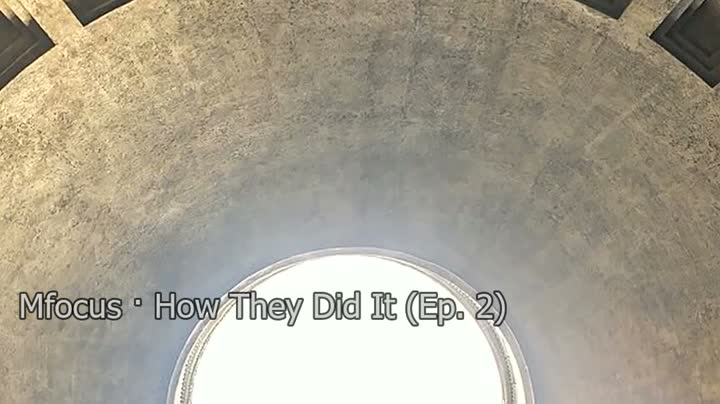

In the historic center of Rome stands the Pantheon, an architectural monument completed between 123 and 128 CE under Emperor Hadrian. Almost 2,000 years later, its enormous dome remains fully intact without a single metal support bar inside. It still holds the world record as the largest unreinforced concrete dome on Earth.
A masterclass in geometry
The interior proportions of the Pantheon form a perfect geometric sphere. The dome spans 43.3 meters (about 142 feet) in diameter, which exactly matches the vertical distance from its marble floor to the central ceiling opening.
Constructing a concrete roof of this scale without steel reinforcement presented an immense physical challenge. Thousands of tons of concrete create outward lateral thrust that can push supporting walls apart.
To prevent structural collapse, Roman architects made the supporting circular rotunda walls exceptionally thick at the base, measuring over 6 meters (about 20 feet) across. As the dome climbs toward the center, the thickness tapers dramatically down to just 1.2 meters (about 4 feet) near the top rim. Builders also carved 140 recessed square coffers into the interior ceiling, which removed substantial weight without sacrificing structural strength.
Lightening the stone
Roman concrete, known as opus caementicium, combined volcanic ash mortar with chunks of rock called aggregates. Roman builders carefully varied these aggregates by density from bottom to top.
At the lowest levels and foundations, they mixed in heavy, dense travertine limestone. Midway up the curve, they transitioned to lighter volcanic tuff. Around the 9-meter central oculus (eye) at the very crown, they incorporated porous volcanic scoria and pumice—airy stones filled with trapped gas pockets. By systematically lightening the materials toward the top, the engineers minimized the downward gravitational load pushing on the lower structure.
Self-healing concrete
For centuries, modern engineers wondered why ancient Roman marine structures and buildings outlasted modern concrete, which often cracks and degrades within decades. In 2023, researchers at the Massachusetts Institute of Technology (MIT) and international collaborators uncovered the answer in the journal Science Advances.
Ancient Roman concrete contains tiny millimeter-scale white mineral chunks called lime clasts. Rather than being a sign of imperfect mixing, these clasts formed because Romans mixed quicklime (calcium oxide) at high temperatures.
When micro-cracks form in the concrete over centuries, rainwater enters the cracks and dissolves calcium from the embedded lime clasts. The calcium-saturated water reacts with carbon dioxide in the air and recrystallizes as calcium carbonate (calcite), effectively sealing the fracture shut. In laboratory tests, cracks healed themselves within two weeks.
Built to endure
Through intelligent geometry, progressive material grading, and self-healing chemistry, Roman builders created a monument that has survived earthquakes, weather, and the passage of two millennia.
Sources
- MIT News (2023) - Riddle solved: Why was Roman concrete so durable?
- PBS Building Big - Pantheon engineering wonder and structural profile
- Pantheon Roma Official Site - The Pantheon Dome: A marvel of ancient Roman architecture
- MIT Architecture Archives - Pantheon dome dimensions, tapering, and materials
This article accompanies episode 2 of our series How They Did It.