
Most people call paper money "paper," but if you accidentally leave a dollar bill in your jeans pocket and run it through the washing machine, it comes out intact. Ordinary paper made from wood pulp would dissolve into soggy mush after a few minutes in soapy water. So what is a United States dollar bill really made of?
Not wood, but cloth
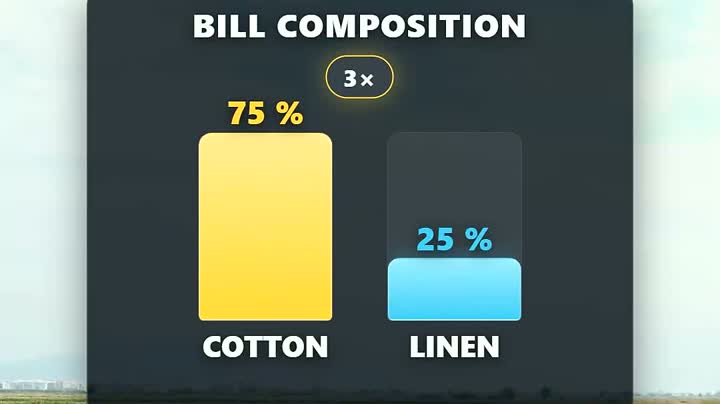
According to the U.S. Currency Education Program, Federal Reserve notes are not manufactured from tree pulp. Instead, American currency paper is a durable fabric blend composed of 75% cotton and 25% linen.
Because cotton and linen are plant textiles rather than wood fibers, the material is technically cloth. This specific blend gives American banknotes their distinctive tactile feel, flexibility, and crisp snap. More importantly, it provides extraordinary physical resilience: a single banknote can withstand thousands of double folds before tearing, surviving the wear and tear of everyday circulation.
Embedded security fibers
If you examine a clean dollar bill closely under a magnifying glass or bright light, you will notice tiny red and blue threads scattered unevenly across the surface.
These threads are not printed onto the bill with surface ink. Instead, small red and blue synthetic security fibers are mixed directly into the cotton and linen pulp during paper manufacturing. Because these colored fibers are embedded deep within the weave of the paper itself, counterfeiters cannot easily reproduce them with standard color copiers or commercial desktop printers.
Printed on giant sheets
Federal Reserve notes are produced by the Bureau of Engraving and Printing (BEP) at high-security facilities located in Washington, D.C., and Fort Worth, Texas. Banknotes are never printed one by one.
Instead, heavy intaglio printing presses apply distinct inks onto large uncut sheets. For decades, the standard press format printed 32 notes per sheet. In recent years, newer state-of-the-art printing systems have expanded production to larger 50-subject sheets for high-volume denominations like the one-dollar note, improving manufacturing efficiency.
Once every sheet is printed and inspected by automated high-resolution cameras for imperfections, precision cutters trim the sheets down into individual banknotes. The notes are then stacked, packaged, and distributed to Federal Reserve banks across the country.
Built for everyday survival
A dollar bill passes through thousands of hands, wallets, cash registers, and vending machines during its lifespan. Because it is woven from cotton and linen rather than wood pulp, it resists moisture, friction, and dirt far better than everyday notebook paper.
The next time you pull a banknote from your pocket, remember that you are holding a specialized piece of cloth engineered to survive years of hard use.
Sources
- U.S. Currency Education Program - Denominations, materials, and security features of U.S. currency
- U.S. Bureau of Engraving and Printing - Banknote production and manufacturing process
This article accompanies episode 1 of our series Money Explained.